Showing posts with label synagogue. Show all posts

Saturday, May 28, 2011

Poland -- Hidden Beit Midrash in Bedzin

Photo (c) Ruth Ellen Gruber


By Ruth Ellen Gruber

It's always inspiring to meet yet more people who take it upon themselves to care for and promote sites of Jewish heritage in Poland (and elsewhere). This week, I accompanied Tomek Kuncewicz and his group of fellows at the Auschwitz Jewish Center to the run-down town of Bedzin, where we visited a nondescript apartment that was once a private Beit Midrash, or prayer house -- and still has traces of the vivid paintings that once covered its walls.


photos (c) Ruth Ellen Gruber

In March of this year, young people in the town created a Foundation -- the Fundacja Brama Cukerman (Cukerman's Gate Foundation) -- to conserve and protect the prayer house and make it available for visitors as part of Bedzin's rich Jewish heritage.

The Prayer House is located in an upstairs apartment at Aleja Kollataja 24 -- in a building that was part of a grand complex of tenement dwellings and businesses owned by Nuchim Cukerman. You have to enter a narrow courtyard (open at one end) and climb the stairs.

Courtyard. Photo (c) Ruth Ellen Gruber

Front of Cukerman house. Photo (c) Ruth Ellen Gruber


After World War II, the Prayer House was divided into two rooms and a kitchen, to serve as a flat. The paintings were covered over by cheap paint and stenciling. Apparently the owner always knew about the hidden murals, which became known publicly a couple of years ago, when highschool students were brought in to clear off some of the over-paint with sponges and water.

The discovery of the Cukerman prayer house came on the heels of the discovery four years ago of another private prayer house, known as the Mizrachi synagogue, in a building nearby. The Mizrachi synagogue is closed -- and apparently the paintings have deteriorated seriously over the past four years.

The Brama Cukerman Foundation is also placing plaques on former Jewish sites, including places of business, such as a one-time Jewish cinema house, around town, to create a heritage route.

Hundreds of non-Jewish Poles have dedicated their time and passion over the past 20-30 years to preserve and protect sites of Jewish heritage and memory in Poland. For 10 years now, they have been honored by the Israeli Ambassador each year with an award initiated by the American lawyer Michael Traison and now presented at a ceremony during the Jewish Culture Festival in Krakow.

Award ceremony, at Galicia Museum. Photo (c) Ruth Ellen Gruber

This year's honorees came from Lodz, Rymanow, Ryki and other towns...

Wednesday, May 11, 2011

Italy -- Cherasco synagogue resources, visits

http://www.cherasco2000.com/tour/sinagoga/foto_interno.jpg
Photo: De Benedetti Cherasco 1547 Foundation


By Ruth Ellen Gruber

I've come across a new web site dedicated to the Jewish heritage of Cherasco, in northern Italy's Piedmont region, and in particular to its gemlike little synagogue, located in the heart of the one-time ghetto, which was reopened in 2006 after a full restoration. Dating from the 18th century, the synagogue is noted from its beautiful carved bimah, with spiral columns.

Much of the site's content is still only in Italian, though it looks as if the whole site will eventually have an English edition. Of particular interest are the photo galleries (see the Galleria Multimediale) which includes before and after images of the synagogue -- as well as a detailed photo documentation of the restoration process.

The site was established by the De Benedetti-Cherasco 1547 Foundation, which also sponsored the restoration.

The Foundation was established in 2002 to commemorate
the engineer Gian Giacomo Debenedetti, who died in 1998 and "who dearly loved the city of Cherasco and worked to promote its image and its initiatives in Italy and abroad."

Its stated goals are also to:
Express gratitude to the city of Cherasco, that since 1547 has welcomed numerous Jewish families within its walls, including the De Benedetti family

Maintain cultural ties with France, in remembrance of the armistice signed at Cherasco between revolutionary France and the Kingdom of Sardinia on 28 April 1796, an event that resulted in the introduction of the values of the French Revolution and in the emancipation of the Jews of Cherasco to the city

Develop ties with the country of Israel, initiated by the through the twinning of Cherasco with the city of Qiryat Gat

Guided tours of the synagogue are offered various Sunday afternoons in coming months -- June 14, 21, 28 ; August 30; September 6 and 13; October 18 and 25; and November 1. Private visits can be arranged during the week, by reservation.

Contact:
Codess Cultura Società Cooperativa
via S. Anselmo 6 10125 - Torino
Tel. +39 011 6699725
Fax +39 011 6508190
www.codesscultura.it

Tuesday, May 10, 2011

Poland -- Upcoming commemorative and cultural events

By Ruth Ellen Gruber

In Poland, there may be only 15,000 (or so) Jews -- but the summer months are filled with Jewish culture and heritage events. This year is no exception.

From big Jewish culture festivals, to individual commemorative events marking sites of Jewish heritage, much is going on. Some are sponsored by local civic organizations, some by committed local activists, some by the Israel embassy, some by local Jewish communities and Jewish organizations -- and some by a combination of organizers and funders who work together on the projects.

This month will see at least two commemorative events.

This Sunday, June 14, a ceremony will take place in the little town of Brzostek to memorialize the destroyed Jewish community there. It will formally rededicate the Jewish cemetery, which has been newly fenced put in order, and also unveil a Hebrew-language monument. In the course of restoring the cemetery, some 30 old tombstones, which have come to light in recent years, were re-erected. In addition, a plaque will be dedicated in the town center -- in Polish and English -- in memory of the former Jewish residents of the town. The project is being carried out in full co-operation with both the chief rabbi of Poland, Michael Schudrich, and the Brzostek town council.

Rabbis and local dignitaries will attend the ceremony, as will pupils from local schools.

"The town is regarding it as a major civic event and organizing various exhibitions on Brzostek's Jewish history," writes Connie Webber, the head of the Littman Library Jewish publishing house, said in an email. "Everyone with a Brzostek connection is invited to participate. Buses will be arranged to and from Krakow on the Sunday, and arrangements have been made for kosher food to be available both on the Sunday and for the preceding Shabbat in Krakow."

Connie and her husband, the scholar Jonathan Webber -- who family stems from Brzostek -- have been instrumental in organizing the commemoration.

Just one week later, on June 22, a plaque commemorating the former Scheinbach Synagogue building (today the town library) will be unveiled in Przemysl, in the far southeast of Poland on the border with Ukraine. Participating will be guests from Poland and abroad. The plaque is a joint initiative of the Foundation for the Preservation of Jewish Heritage in Poland and Michael Freund of Raanana in Israel.

Located at ul. Slowackiego 15, the synagogue was built for the Reform community in 1886-1890 and was designed by Marceli Pilecki. (Another synagogue in the town, built in 1909, stands abandoned and falling ever more into ruin on Plac Unii Brzeskiej, in the Zasanie district across the river. There is a large Jewish cemetery next to the main municipal cemetery, with tombs from the 19th and 20th centuries.)
(Synagogue photo fodz.pl)


As for Jewish culture festivals -- everyone knows about the big Krakow Jewish Culture Festival -- but a a number of others are in the works in Poland. They include:

Gdansk -- 10th Baltic Days of Jewish Culture. June 14-15

Bialystok -- 2nd Zachor Festival of Jewish Culture. June 15-16

Chmielnik -- VII Meeting with Jewish Culture, June 19-21

Krakow -- Festival of Jewish Culture, June 27-July 5. The Other Europeans concert will be July 3.

Warsaw -- Singer's Warsaw Festival of Jewish Culture, Aug. 29-Sept. 6. A big festival, increasingly similar in scope to that in Krakow.

Lodz -- Festival of the Dialogue of Four Cultures. Usually in September

For an ever-growing list of Jewish festivals in all parts of Europe, check the link in the side bar of this blog!

Wednesday, May 4, 2011

Romania -- Romanian Jewish Heritage Event in London

Close up of the Ark, synagogue in Roman, Romania, 2006. Photo (c) Ruth Ellen Gruber


By Ruth Ellen Gruber

Readers in London can get a taste of the wonderful architecture of Romanian synagogues by attending a little festival of Romanian Jewish culture June 11-17 at the Romanian Culture Institute. The opening event takes place June 10.

Centerpiece is the exhibit of Christian Binder's photographs of synagogues of Romania, organized by Julie Dawson (who will speak at the London events).

The Romanian Cultural Institute London, in partnership with Mihai Eminescu Trust (MET) and with the support of Spiro Ark organises an event highlighting Romania's rich Jewish cultural heritage: Synagogues of Romania, an exhibition of photographs of synagogues in southern Transylvania, accompanied by presentations from Andrei Oisteanu, Julie Dawson and Letitia Cosnean and klezmer music live concert with Kosmos Ensemble.

"In the wake of the Holocaust and subsequent mass migration of the vast majority of Romania's Jewish population, countless synagogues fell into various stages of disrepair and decay. This photo exhibition aims to capture the transitional stage in which Romania now finds itself. With the entrance of foreign investors and NGOs, some synagogues are being restored, turned into cultural centers or finding alternative uses. Others remain abandoned, assuming a central location in the town's center and representing an evocative, stubborn reminder of the recent and troubled past."
Julie Dawson, curator
Photography: Christian Binder | http://www.pbase.com/binderch/synagogues

The event brings together:

  • the photographic exhibition;
  • presentations: Julie Dawson and Letitia Cosnean will lecture about "The Plight of Romanian Synagogues" and the "Restoration of the Medias Synagogue" respectively, Andrei Oisteanu will talk about "Jewish Culture in Romania".
    Mr Oisteanu will also present his recent book Inventing the Jew. Antisemitic Stereotypes in Romanian and Other Central-East European Cultures, published by University of Nebraska Press, USA.
  • klezmer music live concert given by the Kosmos Ensemble.
The event will take place in the presence of HE Dr Ion Jinga, the Ambassador of Romania in the UK.

Julie Dawson works in Romania and has traveled extensively throughout Eastern Europe visiting both shtetls and former centers of Yiddish culture. She has been instrumental in organizing regional Yiddish/Jewish cultural events including klezmer and Yiddish song concert tours, photo-documentary exhibitions and community education programs.

Letitia Cosnean is MET's architect in Sighisoara and her lecture will shed light on the restoration process of the Medias Synagogue.

Andrei Oisteanu is a Romanian historian whose research fields include: ethnology, cultural anthropology, history of religions and mentalities. His writings are seen as a considerable contribution to researching magical and ritual practices as well as mythical and religious symbols. He is also noted for his work in Jewish studies and the history of anti-Semitism; Oisteanu has been the first researcher to have developed a complete study in image ideology focusing on the way in which Jewish people were represented within the Romanian mentality and folklore.

Kosmos is an innovative ensemble that composes original music in which there is space for improvisation. Offering a unique sound free from borders or labels, the ensemble aims to explore the boundaries of Western Classical music with Eastern European, Gypsy, Balkan, Klezmer and Tango with contemporary influences. Since their debut in 2005, Kosmos has been enthusiastically acclaimed by audiences at festivals and music societies across Europe.

When: Opening: 10 June 2009, 6 - 8 pm
Photography exhibition: 11-17 June, 10 am - 6 pm
Where: Romanian Cultural Institute, 1 Belgrave Square, London SW1X 8PH
Admission: free for the exhibition. Opening: by invitation. We have a limited number of seats - please get in touch if you want to attend.

Friday, April 8, 2011

Belaus -- Pictures of Luban Synagogue Being Demolished

Sam Gruber has posted a series of pictures, forwarded by Dovid Katz in Vilnius, showing the actual demolition of the synagogue in Luban, Belarus (which I wrote about in earlier posts). Here is one of them:


Writes Sam:
Can this be a wake-up call for better policies in Belarus and elsewhere? This was not a derelict building. It was not a ruined. It was not a forgotten site. It was sacrificed to the demands of contemporary development pressures where expediency and short term gain (to the public tax rolls or to a local politician's campaign war chest or private account) mean more than protecting history and architecture. No community in the world is immune to these pressures. Nor should every old building be saved. But there needs to be in place - in every community - procedures that allow time for review and reflection, and time for world to get out that a building is imperiled.

Monday, April 4, 2011

Belarus -- Synagogue destroyed in Luban

The Associated Press reports that a historic synagogue in the Belarus town of Luban, south of Minsk, is being destroyed to make way for a supermarket. Built in the 19th century, the synagogue is that where the influential orthodox rabbi Moshe Feinstein served before fleeing to New York in 1936. A handful of Jews live in the town today. Officials say the building is not protected as a monument.

LUBAN, Belarus – The roof has been removed and the windows stripped of their frames and glass. Piece by piece, workers are tearing down the former synagogue [. . .]

The synagogue's role in town history was only publicly recognized again in 1996, when a memorial plaque in English, Belarusian and Hebrew was put up on the building, which by then housed a medical clinic. [. . . ]

As the demolition began, the memorial plaque was moved to a nearby building, where it was attached with two crooked, rusty nails. [. . .]

No mention is made of Jews even at the Soviet-era memorial where 785 Jews were shot in November 1941 when the Luban Ghetto was liquidated. The victims are referred to only as "peaceful citizens."


Read full story

Saturday, April 2, 2011

Poland -- Photos of Synagogues

I came across this link to a public Picasa web gallery of photographs of Polish synagogues. Click HERE to see it.

Wednesday, March 23, 2011

Budapest -- Bob Cohen, Lipot Baumhorn and the Main Jewish Cemetery

A tomb designed by Lipot Baumhorn in the Kozma utca cemetery. Photo (c) Ruth Ellen Gruber

Bob Cohen, whose blog (Dumneazu) I've linked to several times in the past, has a post about his first visit to the main Jewish cemetery in Budapest, the enormously huge cemetery on Kozma utca at the end of the 37 tram.

Bob himself finds it astonishing that in all his years in Bp, he has never visited there before -- in fact, I find it astonishing, too, given all the time in past years that I myself have spent there.

Tomb designed by Odon Lechner and Bela Lajta. Photo (c) Ruth Ellen Gruber

The cemetery figures prominently in two of my books, Jewish Heritage Travel, of course, but also in Upon the Doorposts of Thy House: Jewish Life in East-Central Europe, Yesterday and Today, which came out in 1994.

When I first visited, some 20 years ago, the cemetery was pretty much a wilderness -- most of it was overgrown with ivy, saplings, weeds, bushes. Only the very front part was cleared.

My most memorable experience came when I was researching "Doorposts" -- and Ed Serotta accompanied me there to try to find the grave of Lipot Baumhorn, the great synagogue architect, who died in 1932.

I recount the full story in "Doorposts" -- going to the office of the cemetery, having the man there riffle through endless index cards (nowadays the records are computerized) to find the plot. Then following him around the cemetery (first going in the wrong direction) until we found the proper plot -- but no stone, just a huge clump of trees. Then I looked closer and saw that the trees were actually a thick mass of ivy, covering one stone, and I made out a few letters -- it was, in fact Baumhorn's gravestone.

Ed and I ripped away the ivy, uncovering the stone: it was a very emotional experience. On the stone's face was a list of synagogues that Baumhorn had designed or remodeled... at the top was a bas relief of his masterpiece, the dome of the synagogue in Szeged. Then, there was an epitaph written in highly complex, poetic language by the great Rabbi of Szeged, Immanuel Löw, about how he sought synagogues in heaven.... I took the Hungarian original to a series of friends around the city who put together different translations of the difficult lines.

This is the way that the architect and architectural historian Janos Gerle rendered the poem:

Our inspired artist: His inspiration and heart gave birth
To the lines of synagogues that look toward heaven and awaken piety.
Above his peaceful home hovered devotion;
The soul of a father and husband gave birth of heaven-seeking consolation.

In Szolnok, outside the LB synagogue, 2006

Saturday, March 19, 2011

RUTHLESS COSMOPOLITAN at the Bratislava seminar

Synagogue in Sarmorin, the At Home Gallery, 2009. Photo (c) Ruth Ellen Gruber

My latest Ruthless Cosmopolitan column is from the milestone Bratislava seminar on the care, conservation and maintenance of historic Jewish property.

March 26, 2009

By Ruth Ellen Gruber

BRATISLAVA, Slovakia (JTA) – The restitution of Jewish communal property in Central and Eastern Europe has been a hot-button issue since the Iron Curtain fell nearly 20 years ago.

But often forgotten amid the slow and painful legal battles to get back historic Jewish properties that were seized by the Nazis or nationalized by postwar Communist regimes is the practical and urgent need to care for, conserve and maintain the properties once they’ve been recovered.

For two decades and more, I've documented, written about and photographed these sites, which include many yeshivas and synagogues.

Many are huge. Many are dilapidated. Some are recognized as historic monuments. Most stand in towns where few, if any, Jews now live. Even basic maintenance can stretch already strapped communal resources.

In March, I joined Jewish community representatives from 15 countries who gathered to address these concerns at a seminar held in the Slovak capital, Bratislava.

The aim of the meeting was to foster networking and cross-border consultation and spark creative strategic thinking. Many participants had never met before and had little awareness of how colleagues in other countries were confronting similar challenges. Some knew little about the variety of Jewish heritage sites in other countries.

The meeting dealt with issues ranging from fundraising to roof repair to what Jewish law says about synagogue re-use.

During the seminar, which was organized by the American Jewish Joint Distribution Committee, the International Survey of Jewish Monuments and the Slovak Jewish Heritage Center, we visited several sites in the Bratislava area to see how some best-practice solutions had been implemented.

One was the former synagogue in Samorin, a small town southeast of Bratislava, built in 1912.

Back in the early 1990s, it was a derelict shell standing silent and empty on the outskirts of the shabby city center. Its lonely position and crumbling façade underscored its poignancy as a surviving relic of the devastated past.

Since then, it has undergone a dramatic transformation.

Owned by the Union of Slovak Jewish Communities, it is now held on a long-term lease by a couple who took over the building in 1995, restored it and transformed it into the At Home Gallery, a center for contemporary art.

The synagogue is used for cultural purposes aimed at the public at large. It even once hosted the Dalai Lama.

It also now forms part of a new tourism and educational trail called the Slovak Route of Jewish Heritage, which links about 20 historic Jewish sites around the country.

In restoring the building, Csaba Kiss and his Canadian-born wife, Suzanne, deliberately chose to retain evidence that the interior had been desecrated. The walls still bear painted decoration, but the paintings are faded and patchy; they have not been retouched or prettied up.

"Our idea was not to touch the walls," Kiss once told me. "They have memories; we can see them. It's special."

At the seminar's conclusion, participants agreed on a set of pragmatic guidelines with best-practice principles and procedures for the Jewish properties.

Jewish heritage, the guidelines state, "is the legacy of all aspects of Jewish history – religious and secular." At the same time, "Jewish history and art are part of every nation’s history and art. Jewish heritage is part of national heritage, too."

These assertions may appear to state the obvious, but given contentious internal Jewish politics and the taboos and prejudice that historically applied to Jewish culture in Europe, they actually articulate crucial basic concepts. And the guidelines as a whole, while non-binding, represent a milestone when it comes to restituted Jewish properties.

Addressing a frequently heard criticism of Jewish communal management style, the guidelines state, "Honesty and transparency are Jewish values and should be especially apparent in the handling of all matters concerning Jewish property." The guidelines urge detailed documentation of Jewish communal properties and heritage sites and underscore the need for openness and collaboration among Jewish and non-Jewish institutions.

Will these guidelines be followed? Probably not to the letter. Financial considerations, legal obstacles, local conditions and human nature, among other things, prevent adherence to ideals.

Still, they form a framework that can influence practice and, perhaps, finally bring these sites the maintenance and preservation they – and the Jewish people – need.

Friday, March 18, 2011

Belarus -- Kobrin Synagogue in Danger

Sam Gruber has begun posting material from the Bratislava Jewish heritage seminar, and probably will provide more detail -- or at least different detail -- than I am posting... after all, he was one of the organizers of the meeting.

At the seminar, he was able to speak at length with Bella Velikovskaja, of the Jewish Heritage Research Group in Belarus (and the Union of Jewish Religious Communities) about the serious threats to the former synagogue in Kobrin, a monumental structure built in 1868 which was restituted back to the Jewish commuity in 2004. The building was used for grain storage and a beverage-production plant after World War II. The government threatens to take back the building unless restoration work begins -- and funds are short.

Sam writes:
The situation at Kobrin is now urgent, because the government which returned the large 19th-century masonry synagogue to the Jewish community in 2004 threatens to take it back unless restoration work begins. This is a situation that is also becoming common in Poland. After holding Jewish properties for a half century or more and letting them deteriorate into near-ruins, they are returned to communities - but without any financial assistance to restore them. Communities must not only quickly find a use for the building, but also the funds to make them work. Sometimes years pass and nothing happens. Sometimes governments demand quick action. I frequently say the situation is similar to being asked to make soup. One is given the carrots and potatoes, but not pot to cook them in, and sometimes not even a fire. Consequently communities are overburdened. In Belarus, there is a real plan for Kobrin. But there is not enough money. And the government threatens to take the building back if nothing happens soon.

Read full post


Wednesday, March 16, 2011

Romania -- Agreement to Restore Zion Synagogue

Zion Synagogue, 2006. Photo (c) Ruth Ellen Gruber

Livia Chereches, whom I met at the recent seminar on managing historic Jewish property in Bratislava, has written with exciting news. The landmark Zion synagogue in Oradea, Romania, is going to (finally) undergo restoration.

A grandiose Neolog temple with a soaring dome, the synagogue is a city landmark that towers over the Cris river. Built in 1878, it was designed by David Busch, the town's chief municipal architect. Its interior features columns, arches, and vaulting decorated by geometric designs (painted by Mor Horovitz from Kosice). The Ark is framed by an elaborate arch and surmounted by a pipe organ.

Interior of Zion Synagogue, 2006. Photo (c) Ruth Ellen Gruber

Livia writes that under an agreement signed by the President of the Jewish Community Oradea, Felix Koppelmann, and the mayor of Oradea, the town will assume control of the synagogue and use it for exhibitions and other cultural purposes, but on occasion it will also be used by the Jewish community for religious purposes.

This year the municipality will renovate the exterior of the building, and meanwhile European Union funding will be sought for the interior. What's more, a planned high-rise parking lot, that developers wanted to build in front of the synagogue, will now be built underground so that the striking view of the synagogue will be left free.

"This seems to be a happy end to a long story with unsuccessful attempts to save the Jewel of the town of Oradea," writes Livia.

Oradea, which has a Jewish community today numbering about 500 members, has about four other synagogues. Two are in the Jewish community compound (one in use and one closed for hoped-for renovation) and two have been converted for other use.

Saturday, March 12, 2011

Bratislava Seminar on Jewish Heritage -- Promotion, Preservation

Information at synagogue in Samorin, Slovakia, now an arts center. Photo (c) Ruth Ellen Gruber


Last week I attended an international seminar in Bratislava on strategies for the preservation, management and promotion of Jewish built heritage in (mainly) post-communist Europe.

In the past 10 or 15 years, many buildings -- including former synagogues -- have been restituted to Jewish communities in these countries. Some (most?) are in poor condition. What can/should be done with them? This was the core issue of what turned out to be a very intensive meeting that combined discussion with on-site visits.

Representatives of Jewish communities in about 15 countries attended, along with a group of experts (including myself). My brother, Sam Gruber, who is president of the International Survey of Jewish Monuments and also blogs on the subject, was one of the organizers and served as the chief moderator. The seminar was sponsored/organized by the JDC (Joint Distribution Committee), the Cahnman Foundation, the World Monuments Fund, the Rothschild Foundation, and Maros Borsky (who heads the Slovak Jewish Heritage Center).

The meeting touched on many aspects of the broad issue -- from Jewish law (Halacha) regarding synagogue buildings and cemeteries to fund raising to tourism promotion.

I will try to post several short reports, touching on specific aspects of what was discussed or emerged, rather than an overview.

Monday, March 7, 2011

Czech Republic -- Ustek

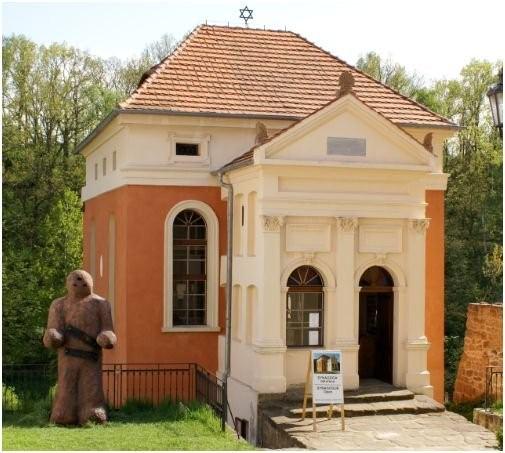
My latest photo and comment (in Italian) are up at the moked.it site -- a Golem guarding the recently restored synagogue in Ustek, CZ.

Photo (c) Ruth Ellen Gruber

Friday, March 4, 2011

Vercelli -- Synagogue under Restoration

An article (in Italian) on the web site of the Union of Italian Jewish Communities describes the process of restoration that is current under way for the synagogue in Vercelli, between Milan and Turin in northern Italy. The synagogue stood almost abandoned and in very dilapidated condition for years. But some restoration work was carried out in 2003 and 2004, and a €700,000 project was begun in 2007. A very small Jewish community lives in Vercelli; community president Rossella Bottini Treves says that once restored, the synagogue will serve as a cultural space for the city. Read full article (in Italian).


The Vercelli synagogue: Photo from www.moked.it

The synagogue, inaugurated in 1878, was designed by Marco Treves, the Vercelli-born architect who also designed the synagogue in Florence. With its Moorish-style striping and flat, tripartite facade with a raised central portion, it resembles several important synagogues in Central Europe whose design was inspired by the Tempelgasse synagogue in Vienna, designed by Ludwig von Foerster and built in the 1850s, which was destroyed on Kristallnacht -- these include the destroyed synagogue in Zagreb and the Choral Synagogue in Bucharest, among others.

Choral Synagogue, Bucharest, 2006. Photo (c) Ruth Ellen Gruber

Synagogue in Vrbove, Slovakia, 2006. Photo (c) Ruth Ellen Gruber

Tuesday, March 1, 2011

Ukraine -- New Web Resources on L'viv

Memorial plaque at the Golden Rose synagogue. Photo (c) Ruth Ellen Gruber


The L'viv Center for Urban History of East Central Europe has posted on its web site some valuable and easy-to-use new resources about Jewish heritage in L'viv. All are part of the Center's ongoing "L'viv Interactive" project on local history, culture and architecture.

One is a detailed description and photo gallery on the Golden Rose Synagogue.

The other comprises two galleries of images relating to the "Inner" Jewish community quarter, where the Golden Rose is located, not far from the main market square, or Rynok. They are part of a research project on the district being carried out by third-year architecture students. Its aim is
to accumulate a database of scholarly elaborations of archival and bibliographical data, live research, as well as visual (videorecordings, photogallery, graphic materials) and verbal (interviews) information. This data can contribute to the cause of discovering, bringing back and renewing the memory of the Jewish legacy in Lviv.

The project proposes to illuminate the history of the city quarter, once inhabited by Jews, provide detailed descriptions of Jewish sacred and public buildings, and trace the development of residential construction, supplemented by information on the owners and residents of the houses. The project will contribute to the cause of illuminating and popularizing Jewish history, culture, tradition and art, both for the residents of Lviv, and for visitors to te city, as the Jewish legacy of Lviv is undoubtedly an important element of promoting the city.

The project was envisioned as an experiment for the historic part of the city, which is included in the UNESCO cultural heritage list.


One of the galleries is a catalogue of images showing the places where mezuzahs were once placed on doorposts -- scars that were once a frequent sight in many towns in east-central Europe.

The other is a set of drawings of specific buildings in the neighborhood.

Wednesday, February 9, 2011

Italy -- Biella synagogue restored


Photo from moked.it

The gem-like synagogue in Biella, near Torino and Vercelli in the Piedmont region of northwest Italy, has been rededicated after "important and decisive" restoration.

Dating from the early 17th century, the synagogue, at vicolo del Bellone 3, occupies the top floor of a medieval house in the heart of what was the historic Jewish quarter. The sanctuary is small and rectagular in shape, focused on a spendid 17th-century Ark and an oval, waist-high carved wooden enclosure around the Bimah.

The €350,000 restoration, overseen by the Jewish community in Vercelli and funded in part by the Piedmont Region and a local bank, included structural consolidation and repair of the roof, which threatened collapse, as well as restoration of the elaborate Ark, the women's gallery and other interior fittings. Further restoration work is planned.

For Italian readers, you can see fuller details by clicking HERE. You may also contact the president of the Vercelli Jewish community, Rossella Bottini Treves, at comebravc.presid@libero.it

The Biella synagogue is one of about 16 beautiful synagogues in Piedmont, many of which have been restored in recent years and can be visited. You can find some information on the Jewish Community of Torino web site. Also, Sam Gruber has written an essay about these synagogues which can be found in a new volume about Jews in Piedmont.

See also the web site for the synagogue at Casale Monferrato, the most elaborate of the synagogues in the region, which is now used (mainly) as a Jewish museum and culture center.

Sunday, February 6, 2011

Slovenia -- Maribor synagogue defaced

Maribor synagogue, Jan. 18, 2009 -- photo from Slovenian Press Agency

Several synagogues in Europe have been the target of vandalism (or worse) linked to the situation in Gaza.

The latest is the historic former synagogue in Maribor, Slovenia, which was daubed with anti-Semitic graffiti over the weekend -- click HERE to see more pictures showing the walls of the building covered with "Judan Raus" and "Gaza."

The synagogue in Maribor, now used as a cultural center, is one of Slovenia's most important Jewish heritage sites and one of the oldest known synagogues in Europe.

It stands in the heart of the medieval Jewish quarter (still known as Zidovska ulica) and is believed to date from the 13th century. Its exact date and original appearance are unknown, however. Already in 1501 -- a few years after the Jews were expelled from that part of Slovenia -- it was converted into a church. It functioned as a church until the late 18th century. In the early 19th century it was sold and turned into a warehouse and, later, a dwelling.

Long empty, the building was renovated in the 1990s and reopened as a cultural center in 2001. The only physical evidence that the building was once a synagogue is the large niche in the eastern wall, presumably for the Ark. Also, numerous stone fragments with carved Hebrew inscriptions were found during excavations for the renovation.

Thursday, February 3, 2011

Synagogue restored in Beirut

This is a bit out of the 'hood, but Haaretz runs a nice piece about the restoration of the Maghen Abraham Synagogue synagogue in downtown Beirut....

Renovations on the ruined synagogue, which was built in 1925, began in 2009
after an agreement between various religious denominations and permission from the Lebanese government, planning authorities and even Hezbollah. The project received the green light after political officials and community leaders became convinced it could show that Lebanon is an open country, tolerant of many faiths including Judaism. [...]

Renovations have included mending the gaping hole in the Moroccan-style synagogue's roof and repairing the chandeliers that once hung from it. The Torah ark and prayer benches will also be refurbished to their former states, having been seriously damaged in fighting between Muslim and Christian forces during the 1975-1990 Lebanese civil war.

Several dozen Jews still living in Lebanon will fund the project to the tune of $200,000, along with others in the Diaspora. The project has also received a $150,000 grant from Solidere, a construction firm tasked with rebuilding central Beirut from the destruction of the civil war. The company is privately owned by the family of Rafik Hariri, the former prime minister assassinated in 2005.
Read full story by clicking RIGHT HERE

Wednesday, February 2, 2011

Pisa -- Vandalized Synagogue Already in Bad Repair

I filed a brief story for JTA about a vandal attack this week on the synagogue in Pisa, probably linked to the crisis in Gaza. Five eggs filled with red paint were thrown at the buildings facade, leaving five red splashes, like blood.

The Pisa Mayor said the city will take care of cleaning up the damage. But the sad fact is that the synagogue as a whole is a very bad repair. Writing on moked.it, the web site of the Union of Italian Jewish Communities, Journalist Piera Di Segni says it is in a "particularly alarming" state, closed for use for more than a year because of serious structural damage and a hole in the roof. Photographs on the site show missing tiles in the roof.

You can see an earlier article, from last summer, in the Florence newspaper La Nazione, by clicking HERE.

The synagogue was built in the 16th century (transforming an earlier medieval structure) and remodeled in the 1860s by the architect Marco Treves.

The Moked.it article is part of a series the site is posting on Jewish cultural heritage in Italy.

For Italian-readers, I'm posting Piera Di Segni's entire article below. You can see the entire series at the culture section of the moked.it site.


pisaBeni da salvare 6
Pisa: “La sinagoga è in pericolo”

Nel panorama del patrimonio artistico ebraico italiano c’è una situazione particolarmente allarmante: la sinagoga di Pisa. Inagibile a causa di gravi danni al tetto e alle strutture, è chiusa da oltre un anno. “Noi qui svolgevamo le funzioni religiose il sabato e le feste, ora siamo costretti a pregare nel sottoscala”, è il grido di dolore che arriva da Guido Cava, presidente della comunità. La situazione danneggia prima di tutto la vita religiosa della comunità, ma non solo: ”la sinagoga era aperta alle scolaresche di tutta la regione che facevano qui delle visite guidate e imparavano qualcosa sulla nostra storia, sull’ebraismo“ aggiunge il presidente. Il fatto che sia chiusa “è un danno per tutta la collettività”.
Al piano terra, alla base di un ampio scalone, sono sistemati alcuni banchi e un Aron, un oratorio improvvisato dove gli ebrei di Pisa, nell'ultimo anno, si sono adattati a fare tefillah.
pisa-tettoE quando si entra nella sala di preghiera, al primo piano, si notano subito i segni dei danneggiamenti: crepe che si aprono come ferite lungo i muri e la volta, macchie di umidità che mangiano a poco a poco i colori delle decorazioni, macchie bianche di intonaco che tradiscono interventi fatti con urgenza, per bloccare danni maggiori.
Salendo fino al matroneo, più vicino alla volta, sono ancora più visibili i danni provocati dal lento e inesorabile stillicidio dell'acqua penetrata attraverso il tetto, che si era infiltrata anche nell'Aron, l’armadio che custodisce i rotoli della Legge.
La sinagoga di Pisa, in via Palestro, nei pressi del Teatro Verdi e non lontano dall’Arno, fu ristrutturata nelle sue forme attuali a metà dell’800, modificando un tempio che risaliva al 1500, nato a sua volta dalla trasformazione di antichi edifici medievali.
Il progetto fu affidato all’architetto Marco Treves, nato a Vercelli, protagonista dell’architettura sinagogale dell’epoca dell’emancipazione in Italia: nell’archivio della comunità sono conservati alcuni suoi disegni autografi che illustrano il progetto col sapore del tempo. La facciata è semplice, ma ben riconoscibile dall’esterno. La sala di preghiera, sobria ed elegante, in stile neoclassico, è illuminata da ampie finestre sui due lati; il matroneo è sorretto da colonne e la sala è sormontata da una volta ricca di decorazioni.
“La volta è una carena di nave rovesciata: sotto al tetto ci sono delle doghe di legno, dei travicelli che sorreggono un incannucciato. Questa base di cannette è stata intonacata a calce e poi sono state fatte le decorazioni, che sono tempere, non affreschi”, spiega l’ingegner Piero Cesare Rini.
La volta ha subito gravi danneggiamenti: crepe, macchie di muffa e di umidità sono i segni visibili di un danno ancora più grave. Un anno fa forti infiltrazioni d’acqua hanno provocato un crollo del tetto. Approfittando del varco i piccioni vi hanno nidificato, producendo quintali di guano e peggiorando la situazione. Il danno è stato tamponato provvisoriamente, con un primo intervento d’urgenza di 35.000 euro finanziato con i fondi della legge 175. Ma le strutture e la volta corrono seri rischi. “La copertura a volta e il tetto sono interconnessi tra di loro, non possono essere smontati e rimontati, vanno restaurati” sottolinea l’ingegner Rini. Si prospetta dunque un intervento molto delicato e complesso che viene ad aggiungersi al complessivo progetto di restauro architettonico e archivistico per il quale sono stati richiesti i finanziamenti della legge 175 per oltre 600 mila euro.
“Il meccanismo dei finanziamenti è complicato” spiega Federico Prosperi, un giovane medico che, da volontario, si occupa degli aspetti burocratici “prima si fa il lavoro poi, a consuntivo, arrivano i rimborsi. Per una comunità piccola come quella di Pisa è molto difficile trovare i fondi da anticipare, e si tratta di centinaia di migliaia di euro”.
La chiusura della sinagoga sottrae agli ebrei di Pisa il loro centro vitale, ma piano piano si affrontano le varie fasi del restauro: alcuni lavori sono già stati effettuati, iniziando da un importante lavoro sull'impianto elettrico. La speranza è che attraverso i finanziamenti richiesti questa bella sinagoga torni ad essere il centro della vita della comunità e venga e restituita alla città, come parte importante della storia e della cultura ebraica, ma anche pregevole testimonianza del patrimonio artistico italiano.

Piera Di Segni

Sunday, January 23, 2011

India -- Jewish Heritage Trail here, too!

The Jerusalem Post runs a lengthy article by Shalva Weil about a nascent Jewish heritage trail in southern India. It is pegged to the situation of the 17th century synagogue in Parur, which is currently being renovated by public authorities after remaining abandoned and somewhat derelict for decades.

Last month, the government of Kerala, India’s southernmost state, armed with a matching grant from the central government, started the reconstruction of the Parur synagogue that used to be frequented by Cochin Jews before they came on aliya, largely in the 1950s. The last of the community immigrated in the 1970s, leaving behind a mere handful of people, and the synagogue has remained in disuse since then. Today, fewer than 40 Cochin Jews remain on the Malabar coast.

The conservation is progressing at such a pace that the chief architect in charge of the project, Benny Kuriakose, believes it will be completed by the autumn. This governmental and federal project could be a beacon for other countries, which pay lip-service to the preservation of Jewish heritage.

“I was very excited to hear that the Kerala government is renovating the Parur synagogue and restoring it to the glory of its past,” said Tirza Lavi, a native of Parur, and a today a curator of the Heritage Center for Cochin Jews at Nevatim, south of Beersheba. “We hope that Parur will be a showcase to the younger generation, displaying our communities’ rich and interesting history. I am sure that Cochin Jews in Israel will be glad to take part in the project and share their knowledge and memories.”

Weil writes that the Jewish heritage trail and Parur synagogue are part of a much larger project.

The reconstruction of the Parur synagogue is only a small cog in the wheel of a huge project called the Muziris Heritage Project, which includes archeological excavations and the reconstruction of other historical monuments in the area, such as temples, churches and mosques. The idea is to create a tourism trail from the ancient port of Muziris, today known as Kodungallor, through Cochin, Parur and other nearby areas, and develop the already-existing tourism boom. Today, Kerala is the eighth most favorite tourist destination in the world.

The seeds of the monumental project were planted only a few years ago. The beautiful Paradesi synagogue in Jew Town, Cochin, constructed in 1568, has been a well-known tourist site ever since Indira Gandhi attended its quatercentenary celebrations in 1968 and the Indiangovernment issued a special commemorative stamp on the occasion. In more recent history, however, the Kerala government agreed to undertake the renovation of another abandoned Cochin Jewish synagogue belonging to the Malabari Jews in the village of Chendamangalam, near Cochin. In February 2006, the synagogue was reopened with an exhibition on the Cochin Jews, and the synagogue has become a popular tourist destination.


Read full article here